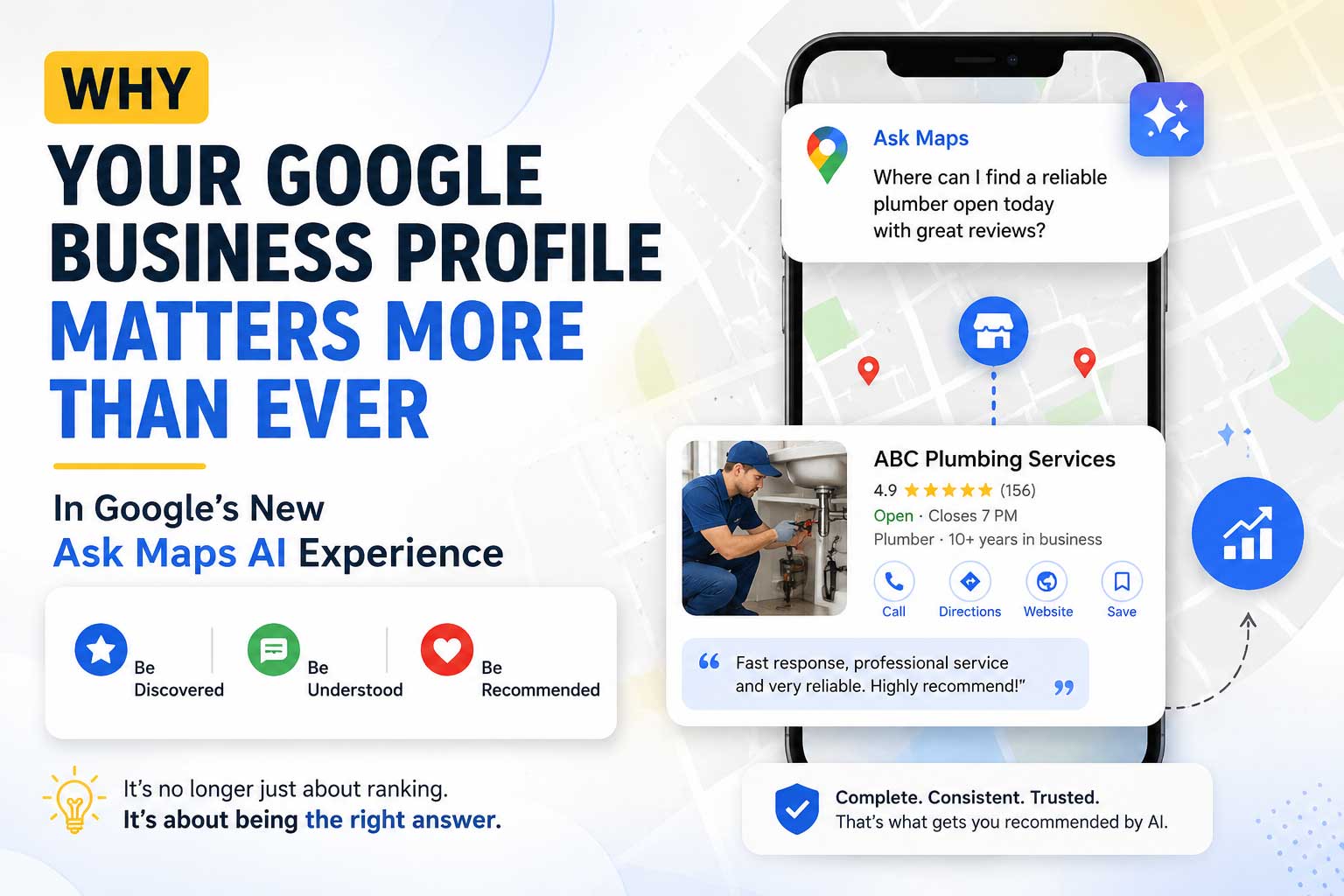
Why the future of local search is shifting from rankings to recommendations.
For years, local SEO has been about one goal: getting your business into Google’s Map Pack.
You optimized your Google Business Profile, collected reviews, added photos, and hoped to rank in the top three.
That strategy still matters.
But Google has introduced something that changes how people discover local businesses: Ask Maps, a new AI-powered experience built on Gemini. Instead of showing users a long list of businesses, Ask Maps lets them ask questions in natural language, such as:
- Where can I find a quiet café with fast Wi-Fi to work for a few hours?
- Which plumber can fix a leaking pipe today and has great customer reviews?
- Show me a family-friendly restaurant with outdoor seating and vegetarian options.
Rather than simply listing businesses, Ask Maps interprets the user’s intent and recommends businesses it believes are the best fit.
That raises an important question for every business owner: Is your business giving Google enough information to confidently recommend you?
From “Showing Up” to “Being Recommended”
Traditional Google Maps relied heavily on factors like proximity, relevance, and prominence.
Ask Maps still considers those signals, but it adds another layer.
It tries to understand:
- What your business actually specializes in.
- What customers consistently say about you.
- Whether your website, reviews, and Business Profile tell the same story.
- Whether it can confidently explain why your business matches a specific request.
In other words, Google isn’t just asking:
“Should this business appear?”
It’s also asking:
“Can I confidently recommend this business?”
That’s a very different standard.
Why Your Google Business Profile Matters More Than Ever
Many business owners treat their Google Business Profile as something they set up once and rarely revisit.
That approach made sense when it functioned primarily as a directory listing.
Today, it’s becoming a source of information that Google’s AI uses to understand your business. Google has even introduced AI-assisted tools to help businesses improve profile descriptions, highlighting the importance of complete and accurate information.
If important details are missing, Google’s AI has less context to work with.
What Makes a Business Easier for AI to Recommend?
You don’t need to “optimize for AI” as if it’s a completely different discipline.
Instead, focus on making your business easier to understand.
1. Describe what you actually do
Avoid vague descriptions.
Instead of:
“We provide quality services.”
Be specific.
Mention your services, industries, specialties, and unique strengths.
The more context you provide, the easier it becomes for AI to match your business with detailed searches.
2. Reviews Matter Beyond Star Ratings
Five-star ratings are valuable.
But the words inside reviews may become even more important.
If customers naturally mention things like:
- Fast response
- Friendly staff
- Same-day service
- Great for families
- Excellent communication
Those details help Google’s AI understand what people genuinely associate with your business. Community discussions around Ask Maps consistently highlight review text as a key signal.
3. Keep Your Information Consistent
- Your website
- Your Google Business Profile
- Your social media
- Local directories
They should all tell the same story.
If one source says you specialize in eCommerce websites and another barely mentions it, Google receives mixed signals.
Consistency builds confidence.
4. Use Real Photos
Photos are no longer just for attracting customers.
They’re another way Google understands your business.
Show:
- Your office
- Your team
- Your products
- Your work
- Your completed projects
Visual proof reinforces the information in your profile.
5. Keep Your Profile Alive
- Businesses evolve.
- Services change.
- Opening hours change.
- New products launch.
Google generally trusts businesses that maintain accurate and up-to-date information more than profiles that haven’t been updated in years. Regular updates also help AI-generated profile descriptions stay accurate.
My Thoughts
I don’t think Ask Maps is replacing SEO.
I think it’s changing what success looks like.
For years, local SEO was largely about improving visibility.
Now it’s also about earning enough trust for AI to recommend your business.
That’s an important distinction.
Because when someone asks:
“Who’s the best web designer for a local business?”
Google isn’t simply searching for keywords.
It’s trying to identify the business that best matches the user’s needs.
My Take
As someone who’s worked on WordPress websites and SEO projects and helped businesses improve their online presence for over a decade, I see this as less of a technical update and more of a mindset shift.
The businesses that will benefit most aren’t necessarily the ones chasing every new AI trend.
They’re the ones that clearly communicate:
- What they do
- Whom they help
- Why customers trust them
When your online presence consistently answers those questions, you’re not just optimizing for search engines.
You’re making it easier for both people and AI to understand why your business deserves a recommendation.
Conclusion
Google’s Ask Maps reminds us that local SEO is becoming less about appearing in a list and more about being the obvious recommendation.
If your Business Profile clearly reflects your expertise, customer experience, and real-world reputation, you’re giving Google’s AI far more confidence to recommend your business when it matters most.