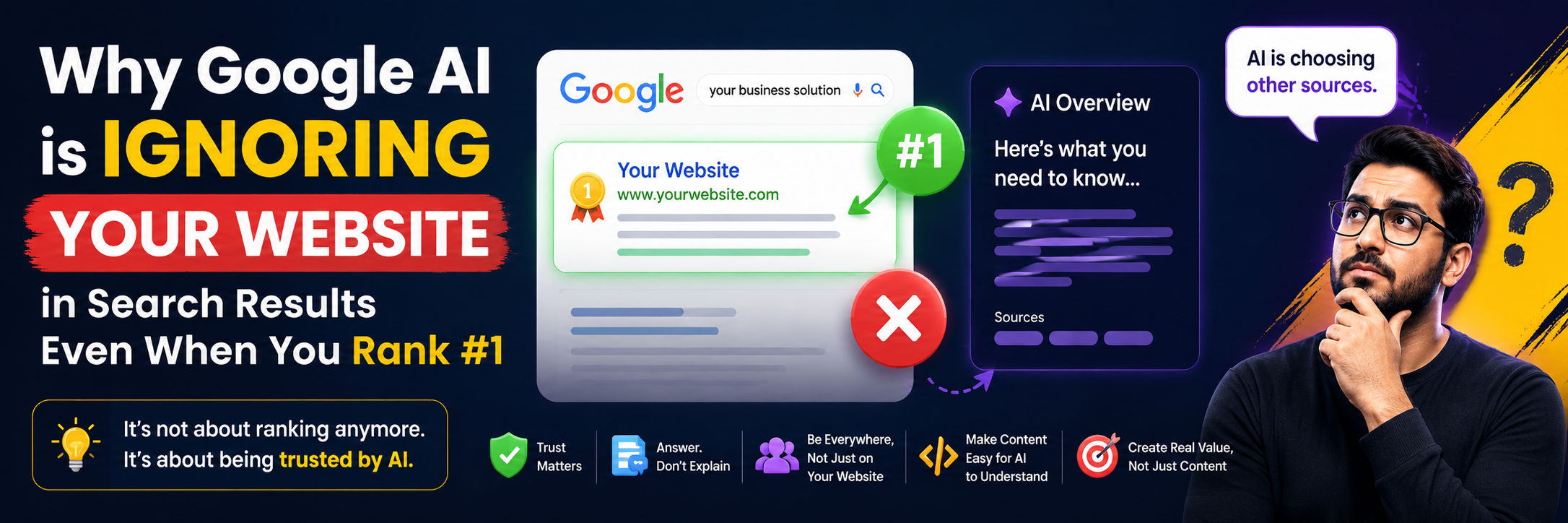
Most business owners still believe that ranking #1 on Google means they’ll automatically appear in Google’s AI-generated answers.
Unfortunately…
That’s no longer true.
Google Search and Google AI now solve different problems.
Traditional Google Search ranks pages.
Google AI selects the best information to answer a user’s question instantly.
That means your website can be sitting at Position #1 while Google’s AI completely ignores it.
What are Google AI Overviews?
Google AI Overviews use AI to summarize and answer a user’s question directly in search results, combining information from multiple trusted sources
Why doesn’t Google AI use the #1 ranking website?
Google AI evaluates more than rankings. It considers content quality, clarity, expertise, trustworthiness, and whether the information directly answers the user’s question.
How can I improve my chances of appearing in Google AI answers?
Create original, well-structured content that answers user questions clearly, demonstrates real expertise, and builds your brand’s authority across multiple trusted platforms.
Is SEO still important in the age of AI search?
Yes. Traditional SEO helps your content get discovered, while high-quality, trustworthy content improves the likelihood of being referenced by AI-generated search experiences.
Why does this happen?
1. Your content ranks, but doesn’t answer.
Many pages are optimized for keywords instead of directly answering the user’s question. AI prefers content that gives a clear answer within the first few paragraphs.
2. AI looks for trust, not just rankings.
Google AI compares information from multiple trusted sources before generating an answer. It looks beyond backlinks and rankings toward overall credibility, expertise, and consistency across the web.
3. Your brand exists only on your website.
Businesses that are mentioned across industry blogs, forums, Reddit, YouTube, LinkedIn, news sites, and other trusted platforms have a better chance of being referenced by AI.
4. Your content isn’t easy for AI to understand.
Large blocks of text, poor headings, weak structure, missing schema, or answers hidden behind unnecessary introductions make it harder for AI to extract useful information.
5. You’re writing for search engines instead of people.
Modern AI rewards original insights, real experiences, examples, comparisons, and expert opinions—not pages rewritten from what everyone else already published.
The biggest mindset shift…
For the last decade, we optimized for:
“How do I rank?”
Today we also need to ask:
“Why would an AI trust my website enough to cite it?”
That single question is becoming the difference between being visible and being invisible online.
SEO is no longer enough.
We’re entering the era of AEO (Answer Engine Optimization) and GEO (Generative Engine Optimization).
This shift has given rise to concepts like Answer Engine Optimization (AEO) and Generative Engine Optimization (GEO), which focus on making content easier for AI systems to understand, trust, and reference.
Ranking gets you discovered.
Trust gets you quoted.
What’s your experience?
Have you seen pages ranking on Google but missing from AI Overviews? Let’s discuss here.